Microtransit Solutions for Underserved Communities
Funded in part by the National Science Foundation under Award CNS-1952011


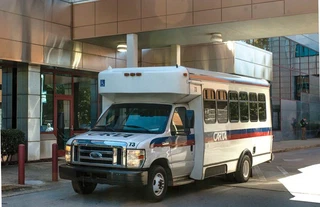
Public transportation infrastructure is an essential component in cultivating equitable communities. However, public transit agencies have historically struggled to achieve this since they are often severely stressed in terms of resources as they have to make the trade-off between concentrating service into routes that serve large numbers of people and spreading service out to ensure that people everywhere have access to at least some service. A solution that holds great promise for improving public transit systems is the integration of fixed-route services with microtransit systems: multi-passenger transportation services that serve passengers using dynamically generated routes and may expect passengers to make their way to and from common pick-up or drop-off points. However, most microtransit systems have failed in the past due to the lack of community engagement, inability to handle the uncertainty of operations when integrating the fixed transit, and inability to handle the system-level optimization challenges.
This project takes a socio-relational approach to community engagement in collaboration with the Chattanooga Area Regional Transportation Authority (CARTA), designs a community-centric micro-transit service that augments fixed-line public transit networks (improving transit accessibility), and demonstrate its effectiveness in the representative city of Chattanooga. The outcome of the project will be a deployment-ready software system that can be used by an agency to design and operate a micro-transit service effectively. The algorithmic toolchain will be complemented by mechanisms to optimally select the parameters and sustainably manage the data required by the algorithms. In addition, this project will provide a set of exemplar case studies and a validated social methodology to engage the community and learn their requirements, which will be fed into the algorithms. This will potentially impact a wide range of cities in the U.S. that do not have well-developed transit systems as the project will not only provide a reusable operations system but also demonstrate how integrated socio-technical research and strong community engagement can provide a pattern for sustainability and expansion.
The intellectual merit of this project lies in the novel community engagement approach and combined operations research and data-driven, learning-based integrated system optimization. Towards this goal, the project will make four key contributions.
- First, the project will develop a novel targeted outreach approach that uses the relational networks of social capital (e.g., outreach to community centers, congregations and faith communities, schools, and similar organizational structures) and builds a categorical demand model to design an innovative micro-transit system. The project’s hypothesis is that the behavioral impact on public-transit ridership with the proposed method will be significantly higher than with an approach that focuses only on the economic or time-saving benefits of the improved transit system.
- Second, the project will introduce a sustainable and resilient data-integration platform that dynamically adjusts the location of the sensor data used to affect the design parameters and assess performance of the transit system. This is crucial because cloud computing is still very expensive for community partners, especially for real-time high-velocity and high-volume data analysis. Further, this data store provides us an opportunity to take a privacy-by-design approach for the datasets collected during the project. Specifically, the project will develop novel integrated anonymization mixers for multi-modal datasets (e.g., mixing information of different modalities, such as location traces and transactions, together in a spatiotemporal-transactional mixer) that achieve a given level of privacy (quantified using the notation of differential privacy) while maximizing the accuracy of transit queries, relying on not just the privacy-properties of the data but also on the needs of the queries.
- Third, the project will develop uncertainty-aware fleet management and dispatch algorithms that incorporate demand aggregation and environmental uncertainty caused by congestion, incidents, and their impact on the system (both for the users and fleet operations).
- Fourth, the project will leverage recent advances in active learning for non-stationary environments with contextual side information to design algorithms that will aid in the exploration and optimal selection of hyperparameters for microtransit algorithms.
Team

Aron Laszka is an Associate Professor in the College of Information Sciences and Technology at the Pennsylvania State University. Previously, he was an Assistant Professor at the University of Houston, a Research Assistant Professor at Vanderbilt University, and a Postdoctoral Scholar at the University of California, Berkeley.
His research interests revolve around artificial intelligence and cyber-physical systems, focusing on machine learning for decision making and optimization, with applications in smart and connected communities, critical infrastructure, and cybersecurity.
His research is funded by the National Science Foundation, the Department of Energy, the Department of Transportation, and other agencies.


