Fixed-Line Transit 2.0: Real-Time Optimization of High-Frequency Transit Service
Funded in part by the U.S. Department of Transportation under the SMART Grants Program


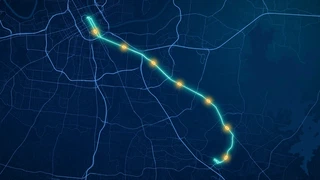
This project will develop and deploy a real-time, AI-driven decision support system that makes high-frequency bus service more reliable by anticipating and proactively mitigating delays, overcrowding, and service disruptions. Frequent, high-ridership bus routes are inherently unstable: when a bus falls behind, it encounters more waiting passengers and falls even further behind, until buses bunch together and leave long gaps in service, causing longer and less predictable waits, overcrowding, and missed transfers. The project focuses on WeGo Public Transit’s Route 55 Murfreesboro in Nashville, Tennessee, WeGo’s busiest route with nearly 5,000 weekday boardings, but also its least reliable one: more than 1 in 4 buses are either bunched or gapped, adding up to over 105 hours of excess waiting time for passengers every weekday. The project is led by WeGo in partnership with the Nashville Department of Transportation and Multimodal Infrastructure, the Pennsylvania State University, Vanderbilt University, and technology companies.
At the heart of the project is an Integrated Decision Support System that fuses heterogeneous real-time data, such as bus locations updated every two seconds, passenger counts, traffic, and weather. Computer vision will count passengers at bus stops and on buses, and machine learning models will forecast bus arrival times, headways, overcrowding, and service disruptions. Building on these forecasts, the system will warn dispatchers of emerging problems and use AI-driven optimization to recommend strategies that prevent them, such as holding or short-turning buses, skipping stops, or inserting standby buses. Adaptive traffic signal control with headway-conditional transit signal priority, continuously optimized using machine learning, will further reduce travel times and their variability, and riders will receive more accurate arrival predictions in their smartphone apps and on digital displays at bus stops.
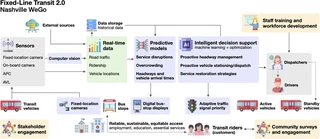
Together with Vanderbilt University, our team at Penn State is responsible for the AI at the core of this system: prediction algorithms for bus arrivals and headways, and a real-time decision support system for dispatchers and drivers. We will create a decision-focused learning framework, in which prediction models trained on spatiotemporal data, such as weather, traffic, and ridership, are incorporated into non-myopic online optimization algorithms for proactive headway management and vehicle stationing. These algorithms will use the learned models to simulate uncertain future trajectories of the transit system and reason through them to improve service reliability. Our approach will combine these strengths of AI with the strengths of human supervisors, whose tacit knowledge and expertise are invaluable for understanding the dynamic challenges of fixed-line transit, while giving supervisors, drivers, and passengers real-time situational awareness of the whole system.
By making frequent bus service faster and more predictable, the project will improve access to jobs, education, and essential services: 65% of Route 55 riders do not have access to a vehicle, and since the route has more transfers to and from other routes than any other WeGo route, the benefits will extend to residents in many other parts of Nashville. More reliable transit may also draw people away from driving, and adaptive signals with transit signal priority will reduce delays at intersections, together reducing congestion and improving energy efficiency. The decision support system will also improve the productivity and job quality of dispatchers and drivers. Unlike dedicated transit lanes, whose construction is a multi-year, resource-intensive undertaking, the system builds on existing infrastructure, such as municipal fiber, onboard sensors, and real-time transit data feeds, greatly reducing the cost, duration, and risk of deployment. Extending it to six additional high-frequency WeGo routes would bring more than 2 in 3 WeGo bus boardings, nearly 20,000 rides per weekday, onto “Transit 2.0” routes, and the approach is relevant to other transit agencies facing similar challenges.
Team

Aron Laszka is an Associate Professor in the College of Information Sciences and Technology at the Pennsylvania State University. Previously, he was an Assistant Professor at the University of Houston, a Research Assistant Professor at Vanderbilt University, and a Postdoctoral Scholar at the University of California, Berkeley.
His research interests revolve around artificial intelligence and cyber-physical systems, focusing on machine learning for decision making and optimization, with applications in smart and connected communities, critical infrastructure, and cybersecurity.
His research is funded by the National Science Foundation, the Department of Energy, the Department of Transportation, and other agencies.

