Amutheezan Sivagnanam

Amutheezan Sivagnanam

Ph.D. 2025
Pennsylvania State University
Amutheezan joined the Applied Artificial Intelligence Lab as a Ph.D. student in fall 2019. His research interest is in Machine Learning and Data Science. Previously, he graduated with a Bachelors’s Degree in Computer Science and Engineering from the University of Moratuwa, Sri Lanka in 2017. He worked as an intern at WSO2 Lanka (PVT) Ltd., as part of the Data Analytics Team in 2016. He also worked as a software engineer in MillenniumIT Software PVT Ltd. from 2018 to 2019. He has previously worked on a machine learning project on semi-supervised based sentiment analysis of microblogging platforms and on a data analytics project on monitoring flows of HL7 messages. Currently, his research work focuses on optimizing bus-route scheduling and minimizing energy costs.
Machine Learning Data Science

Dynamic Vehicle Routing Problem with Prompt Confirmation of Advance Requests

Transit agencies that operate on-demand transportation services have to respond to trip requests from passengers in real time, which involves solving dynamic vehicle routing …

avatar
Amutheezan Sivagnanam
•

AI for Smart Transportation

Public transportation systems worldwide face persistent challenges of efficiency, reliability, and sustainability. In this chapter, we explore how AI-powered approaches can …

Michael Wilbur
•
Rural Transit Solutions for Enhancing Access & Connectivity featured image

Rural Transit Solutions for Enhancing Access & Connectivity

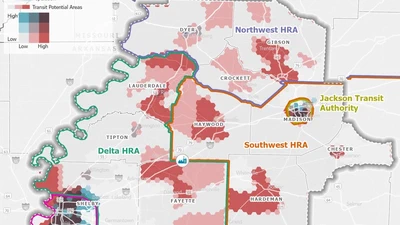
This Civic Innovation Challenge (CIVIC) Stage 1 project will perform research to address transportation challenges faced by residents and workers in rural areas around industrial hubs. Rapid economic growth in these areas demands efficient public transit systems that can serve a geographically dispersed workforce with strict arrival times. However, existing solutions often struggle with these unique requirements, leading to traffic congestion, pollution, and limited access to essential services for residents. This research project will develop and deploy a novel multi-modal transit system for Blue Oval City (BOC), a new rural industrial hub in Stanton, Tennessee. The system will combine fixed-line buses with on-demand micro-transit services, addressing the challenges posed by the geographically dispersed workforce and strict arrival times.

AI-Powered Autonomy-Aware Neighborhood Mobility Zones featured image

AI-Powered Autonomy-Aware Neighborhood Mobility Zones

This project reimagines public transportation for mid-sized U.S. cities through an AI-driven, multi-modal mobility framework that integrates fixed-line buses and on-demand microtransit into a single, responsive system. Led by the Chattanooga Area Regional Transportation Authority (CARTA) with technical contribution from the Pennsylvania State University, Vanderbilt University, and Cornell University, this $7 million initiative is designed to enhance infrastructure utilization, mobility access, and financial viability of public transit in Chattanooga while providing a national model for AI-enabled mobility resilience.

Grid-Aware Charging and Operational Optimization for Mixed-Fleet Public Transit

The rapid growth of urban populations and the increasing need for sustainable transportation solutions have prompted a shift towards electric buses in public transit systems. …

Rishav Sen
•

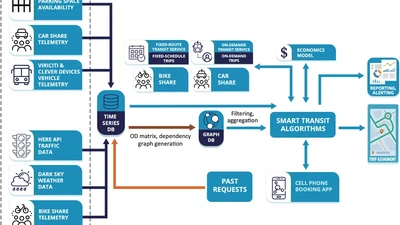
SmartTransit.AI: A Dynamic Paratransit and Microtransit Application

New rideshare and shared mobility services have transformed urban mobility in recent years. Such services have the potential to improve efficiency and reduce costs by allowing …

Sophie Pavia
•

Deploying Mobility-On-Demand for All by Optimizing Paratransit Services

While on-demand ride-sharing services have become popular in recent years, traditional on-demand transit services cannot be used by everyone, e.g., wheelchair-bound people. …

Sophie Pavia
•

Multi-Agent Reinforcement Learning with Hierarchical Coordination for Emergency Responder Stationing

An emergency responder management (ERM) system dispatches responders, such as ambulances, when it receives requests for medical aid. ERM systems can also proactively reposition …

avatar
Amutheezan Sivagnanam
•

The Benefits of Vulnerability Discovery and Bug Bounty Programs: Case Studies of Chromium and Firefox

Recently, bug-bounty programs have gained popularity and become a significant part of the security culture of many organizations. Bug-bounty programs enable organizations to …

avatar
Soodeh Atefi
•

Impact of COVID-19 on Public Transit Accessibility and Ridership

COVID-19 has radically transformed urban travel behavior throughout the world. Agencies have had to provide adequate service while navigating a rapidly changing environment with …

Michael Wilbur
•