Research Areas

Reinforcement Learning

Multi-agent reinforcement learning Adversarial reinforcement learning

Combinatorial Optimization

Learning-augmented optimization Vehicle routing and scheduling

Cyber-Physical Systems

Intelligent transportation Energy and power systems
Projects
NSF CAREER: Scaling Deep Reinforcement Learning for Societal-Scale Cyber-Physical Systems featured image

NSF CAREER: Scaling Deep Reinforcement Learning for Societal-Scale Cyber-Physical Systems

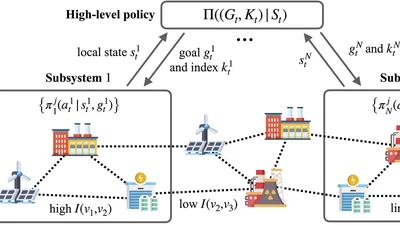
This project will develop artificial intelligence techniques to improve the operation of large-scale infrastructure systems, such as smart transportation networks and electric power grids, which are essential to modern life. These complex systems, known as societal-scale cyber-physical systems, integrate physical infrastructure with thousands of sensors, computing devices, and actuators. Due to their scale and distributed nature, managing these systems in real time poses a significant challenge. To address this challenge, the project will leverage deep reinforcement learning, a form of artificial intelligence that learns optimal decision-making strategies directly from data. By improving the efficiency and reliability of critical infrastructure systems, the research will further the national interest through reducing traffic congestion, improving emergency response times, and increasing the stability of the power grid.
Fixed-Line Transit 2.0: Real-Time Optimization of High-Frequency Transit Service featured image

Fixed-Line Transit 2.0: Real-Time Optimization of High-Frequency Transit Service

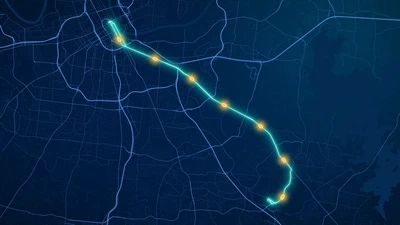
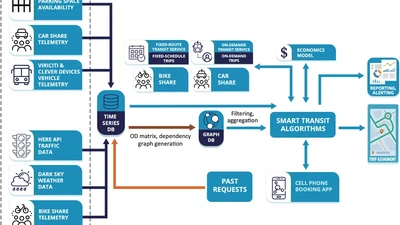
This project will develop and deploy a real-time, AI-driven decision support system that makes high-frequency bus service more reliable by anticipating and proactively mitigating delays, overcrowding, and service disruptions. Frequent, high-ridership bus routes are inherently unstable: when a bus falls behind, it encounters more waiting passengers and falls even further behind, until buses bunch together and leave long gaps in service, causing longer and less predictable waits, overcrowding, and missed transfers. The project focuses on WeGo Public Transit’s Route 55 Murfreesboro in Nashville, Tennessee, WeGo’s busiest route with nearly 5,000 weekday boardings, but also its least reliable one: more than 1 in 4 buses are either bunched or gapped, adding up to over 105 hours of excess waiting time for passengers every weekday.

AI-Powered Autonomy-Aware Neighborhood Mobility Zones featured image

AI-Powered Autonomy-Aware Neighborhood Mobility Zones

This project reimagines public transportation for mid-sized U.S. cities through an AI-driven, multi-modal mobility framework that integrates fixed-line buses and on-demand microtransit into a single, responsive system. Led by the Chattanooga Area Regional Transportation Authority (CARTA) with technical contribution from the Pennsylvania State University, Vanderbilt University, and Cornell University, this $7 million initiative is designed to enhance infrastructure utilization, mobility access, and financial viability of public transit in Chattanooga while providing a national model for AI-enabled mobility resilience.

Rural Transit Solutions for Enhancing Access & Connectivity featured image

Rural Transit Solutions for Enhancing Access & Connectivity

This Civic Innovation Challenge (CIVIC) Stage 1 project will perform research to address transportation challenges faced by residents and workers in rural areas around industrial hubs. Rapid economic growth in these areas demands efficient public transit systems that can serve a geographically dispersed workforce with strict arrival times. However, existing solutions often struggle with these unique requirements, leading to traffic congestion, pollution, and limited access to essential services for residents. This research project will develop and deploy a novel multi-modal transit system for Blue Oval City (BOC), a new rural industrial hub in Stanton, Tennessee. The system will combine fixed-line buses with on-demand micro-transit services, addressing the challenges posed by the geographically dispersed workforce and strict arrival times.

AI for Equitable and Resilient Food Distribution during Disasters featured image

AI for Equitable and Resilient Food Distribution during Disasters

Food insecurity is the lack of consistent and reliable access to nutritious food. In the Houston (Texas) area, over 14% of Harris County households experienced food insecurity before the emergence of COVID-19. It is unclear how the nutritional needs of Houston’s vulnerable populations will be served when the next devastating weather event strikes the region, given that the city is already experiencing multiple disasters, including COVID-19, economic disruptions, and systemic food insecurity. The Houston Food Bank (HFB) collaborates with over 1,500 partners to address the needs of families experiencing food insecurity. Through a community-driven approach, this project brings together civic collaborators with university researchers to align HFB’s food distribution strategy to match food insecurity during multiple disaster profiles. Our project will develop indicators of individual and community equity for food distribution during pandemics and extreme weather events; design a network organizational resilience index for food bank networks and interventions to improve network resilience; develop and validate a predictive tool for infrastructure vulnerability, and develop and validate an artificial-intelligence based decision-making tool for determining the locations of food distribution hubs and their food allocation.

Equitable Electric Mobility: Smart Charging and Smart Parking featured image

Equitable Electric Mobility: Smart Charging and Smart Parking

This Houston-based project establishes a collaborative process with community and commercial technology partners to accelerate the equitable development of accessible fast charging infrastructure and electric vehicle (EV) ownership for low income families by leveraging regional markets of early EV adopters. The novelty of the project lies in a community-driven participatory approach that integrates both social and technical dimensions, bringing transformational change to EV ownership and electrification of smart public transportation. This will be achieved using a data-driven model that integrates real-time data from micro-transit, fixed-route transit, and carpooling services to predict and overcome the uncertainties of traffic conditions, which would result in uncertain travel times and poor reliability.

Selected Publications

Multi-Agent Reinforcement Learning with Hierarchical Coordination for Emergency Responder Stationing

An emergency responder management (ERM) system dispatches responders, such as ambulances, when it receives requests for medical aid. ERM systems can also proactively reposition …

avatar
Amutheezan Sivagnanam
•

Ensemble Prediction of Task Affinity for Efficient Multi-Task Learning

A fundamental problem in multi-task learning (MTL) is identifying groups of tasks that should be learned together. Since training MTL models for all possible combinations of tasks …

avatar
Afiya Ayman
•

Offline Vehicle Routing Problem with Online Bookings: A Novel Problem Formulation with Applications to Paratransit

Vehicle routing problems (VRPs) can be divided into two major categories: offline VRPs, which consider a given set of trip requests to be served, and online VRPs, which consider …

avatar
Amutheezan Sivagnanam
•

Multi-Agent Reinforcement Learning for Assessing False-Data Injection Attacks on Transportation Networks

The increasing reliance of drivers on navigation applications has made transportation networks more susceptible to data-manipulation attacks by malicious actors. Adversaries may …

avatar
Taha Eghtesad
•

Dynamic Vehicle Routing Problem with Prompt Confirmation of Advance Requests

Transit agencies that operate on-demand transportation services have to respond to trip requests from passengers in real time, which involves solving dynamic vehicle routing …

avatar
Amutheezan Sivagnanam
•

Principled Data-Driven Decision Support for Cyber-Forensic Investigations

In the wake of a cybersecurity incident, it is crucial to promptly discover how the threat actors breached security in order to assess the impact of the incident and to develop and …

avatar
Soodeh Atefi
•

Members

Faculty

Aron Laszka

Aron Laszka

Associate Professor

Postdoctoral Researchers

George Gunter

George Gunter

Postdoctoral Researcher

Formal Methods Safety-Critical Control Intelligent Transportation Systems

Ph.D. Students

Braxton Geary

Braxton Geary

Ph.D. Student

Multi-Agent Reinforcement Learning Policy Gradient Methods Credit Assignment
Chaeeun Han

Chaeeun Han

Ph.D. Student

Data Science Adversarial Machine Learning Deep Learning

Alumni

Taha Eghtesad

Taha Eghtesad

Ph.D. 2026

Machine Learning Game Theory Cyber-Physical Systems
Amutheezan Sivagnanam

Amutheezan Sivagnanam

Ph.D. 2025

Machine Learning Data Science
Afiya Ayman

Afiya Ayman

Ph.D. 2025

Data Science Machine Learning Cybersecurity
Salah Uddin Kadir

Salah Uddin Kadir

Ph.D. 2023

Artificial Intelligence Cybersecurity
Soodeh Atefi

Soodeh Atefi

Ph.D. 2023

Data Science Machine Learning
Funding
Our research is supported by the U.S. National Science Foundation (NSF), the U.S. Department of Energy (DOE), the U.S. Department of Transportation (DOT), and other agencies.